TL;DR#
A Windows memory image was provided for analysis. Process enumeration revealed a suspicious ChromeSetup.exe process spawned under explorer.exe, indicating direct user-context execution rather than a legitimate installer flow. Network scan output showed ChromeSetup.exe initiating an outbound connection to 58.64.204.181:5202 in Hong Kong. The process was dumped from memory and submitted to VirusTotal, where it was flagged by 68/72 vendors as Ramnit - a worm and credential-stealing trojan.
Process Analysis#
I started by running windows.pslist against the memory image using Volatility 3.

The process list showed ChromeSetup.exe (PID 4628) as a child of explorer.exe (PID 4568).
Network Analysis#
With a suspicious process identified, I ran windows.netscan to enumerate active and recently closed network connections and correlate them with running processes

ChromeSetup.exe had an active outbound connection in state SYN_SENT to 58.64.204.181:5202 at 19:48:51 UTC - one second after the process started. SYN_SENT means the TCP handshake was initiated but not yet completed at the moment of memory capture, indicating the malware was actively attempting to reach its C2 server. Port 5202 is non-standard and has no legitimate association with Chrome.
I checked the destination IP - 58.64.204.181 resolves to NWT IDC Data Service, Hong Kong. There is no legitimate reason for a Chrome installer to connect to a Hong Kong data center IP on a non-standard port.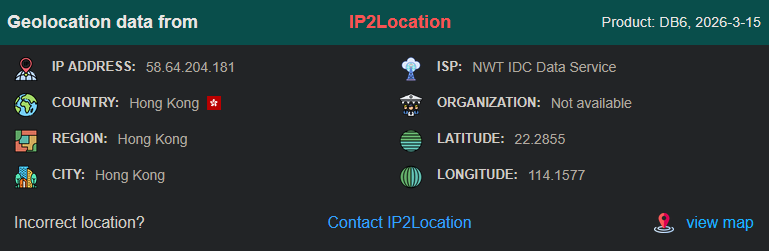
File Extraction and Identification#
With the process confirmed as suspicious through both process tree anomalies and network behavior, I dumped the executable from memory using windows.dumpfiles targeting PID 4628
The dumped file file.0xca82b85325a0.0xca82b7e06c80.ImageSectionObject.ChromeSetup.exe.img was submitted to VirusTotal by MD5 hash 11318cc3a3613fb679e25973a0a701fc.
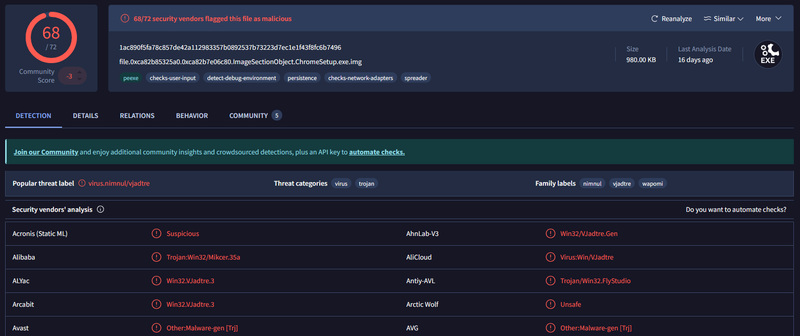
68 out of 72 vendors flagged the file as malicious. The popular threat label is virus.nimnul/vjadtre, with family labels including nimnul, vjadtre, and wapomi. Threat categories are listed as virus and trojan. VirusTotal behavior tags include persistence, spreader, checks-network-adapters, and detect-debug-environmen` - consistent with Ramnit’s known behavior of infecting executables on the local filesystem, spreading via removable drives, and establishing persistent C2 communication.
Attack Timeline#
%%{init: {'theme': 'base', 'themeVariables': { 'background': '#ffffff', 'mainBkg': '#ffffff', 'primaryTextColor': '#000000', 'lineColor': '#333333', 'clusterBkg': '#ffffff', 'clusterBorder': '#333333'}}}%%
graph TD
    classDef default fill:#f9f9f9,stroke:#333,stroke-width:1px,color:#000;
    classDef access fill:#e1f5fe,stroke:#0277bd,stroke-width:2px,color:#000;
    classDef action fill:#ffebee,stroke:#c62828,stroke-width:2px,color:#000;
    classDef c2 fill:#fce4ec,stroke:#880e4f,stroke-width:2px,color:#000;
    classDef start fill:#e8f5e9,stroke:#2e7d32,stroke-width:2px,color:#000;

    A([User
explorer.exe PID 4568]):::start --> B[2024-02-01 19:48:50 UTC
ChromeSetup.exe launched
PID 4628 - 32-bit - Wow64]:::action
    B --> C[2024-02-01 19:48:51 UTC
SYN_SENT to 58.64.204.181:5202
NWT IDC Data Service - Hong Kong]:::c2
    C --> D([Ramnit C2 beacon
virus.nimnul/vjadtre
68/72 VirusTotal vendors]):::c2
IOCs#
IPs
- 58.64.204.181 - Ramnit C2 server (Hong Kong, port 5202)
Files
- ChromeSetup.exe - Ramnit worm masquerading as Chrome installer
- MD5: 11318cc3a3613fb679e25973a0a701fc
- SHA256: 1ac890f5fa78c857de42a112983357b0892537b73223d7ec1e1f43f8fc6b7496
Processes
- PID 4628 ChromeSetup.exe - malicious process under explorer.exe PID 4568
Ports
- 5202/TCP - non-standard C2 communication port